Standing waves form when waves interfere with reflected waves from another direction and form a resulting wave that appears to stand still.
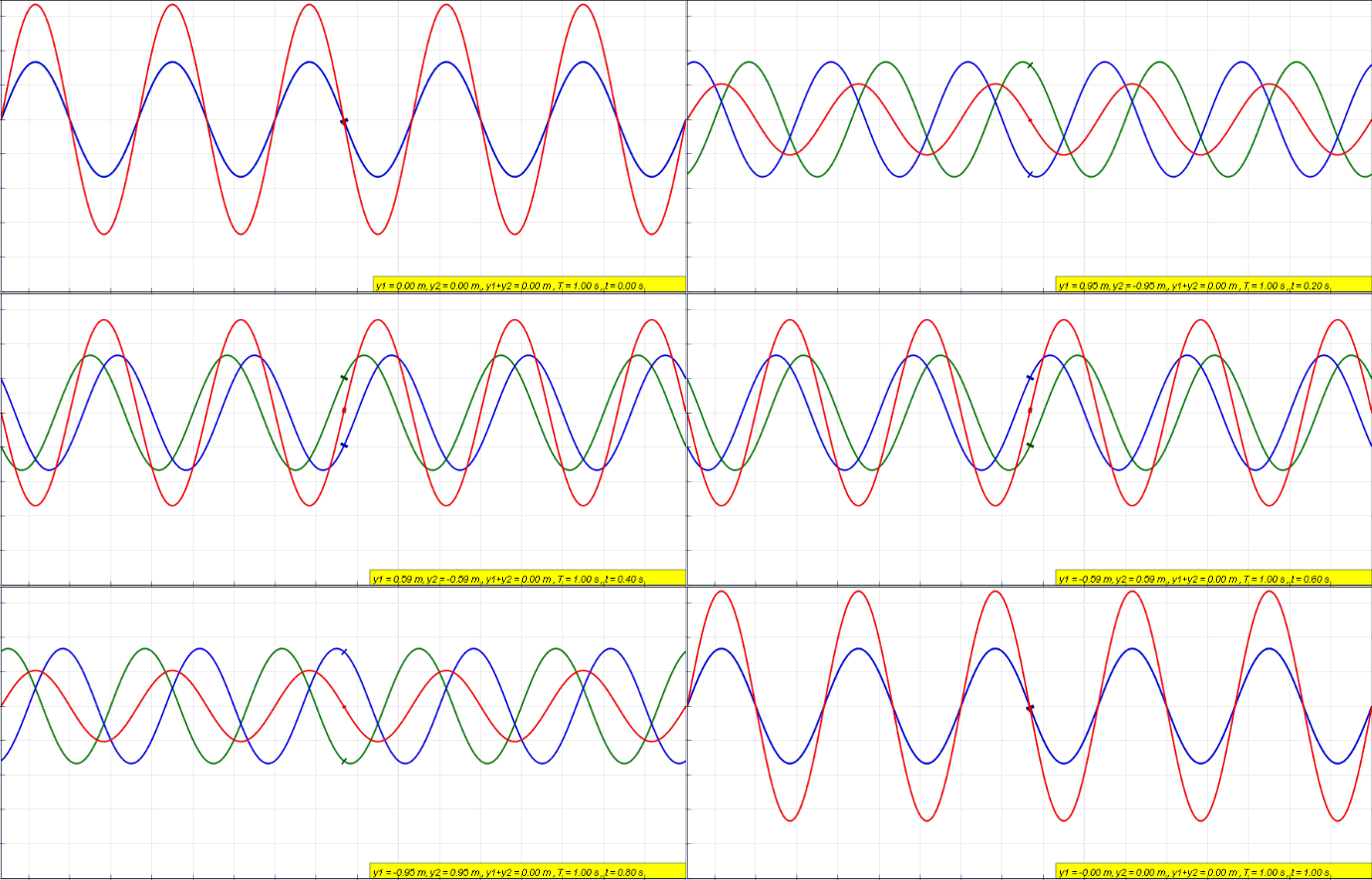
The red wave below is a standing wave. The green and blue waves are moving in different directions and interfering with each other to create the resulting red standing wave.
Study wave interference first if you don’t know that concept yet.
Standing Waves on a String
Standing waves on a string are the easiest to understand visually.
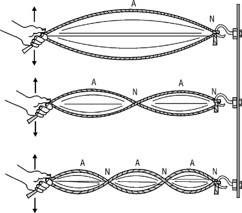
A string is fixed at one end and shaken up and down on the other end. Depending how fast one shakes the string, it forms different standing wave patterns.
The top pattern is the simplest. It’s the slowest frequency that can make a standing wave on this rope, and that frequency is called the fundamental frequency. It makes a half of a wavelength. We can also call this standing wave the “n = 1” wave because it has one half of a wave. Note that with the ends fixed in this way, it’s not possible to make less than a half a wave.
The second wave in the diagram above makes a full wavelength (two half waves, so it is n=2), and the third makes 1.5 wavelengths (three half waves, n = 3) and so on. All of the variations of the standing waves on the same string are called harmonic frequencies.
The mathematical relationships for wavelength and frequency with these different standing waves on a string are as follows:

Where:
f1 = fundamental frequency
f_n = frequency of the nth harmonic
n = harmonic number (number of half wavelengths)
This equation is saying that the frequencies are all multiples of the fundamental frequency.
For example: if the fundamental (n=1) frequency is 30 Hz, what is the n=5 frequency? Answer: (5)(30 Hz) = 150 Hz.

Where:
λn = wavelength of the nth harmonic
L = length of the string
n = harmonic number (number of half wavelengths)
Alternatively:

This is the same equation with a slight rearrangement, but now the idea might be more clear. We’re dividing the length, L, by the number of full wavelengths on the string. For example, for n=4, we have two full waves (four half wavelengths). So the wavelength equals L/2.
Note: waves on a given string medium all have the same speed.
(The speed depends on string diameter, density, etc)
Standing Waves and Harmonics in Music
In music, waves with frequencies that are larger multiples of the fundamental are called overtones. In a musical instrument, the fundamental frequency combines (interferes) with many of the overtones to make a more complex and interesting sound. The quality of the sound is called the timbre. A violin has a different timbre than a trumpet or an oboe. The fundamental frequency alone makes a really plain sounding note, something like our school’s electronic bell tone. This is why different musical instruments can sound different even when they play a note of the same frequency – they have a different mixture of the different harmonics.